Research

Technical Papers

Public research, technical notes, and defensible explanations from Newport Resonance.

Research That Informs the Product

Newport Resonance is working at the frontier of governed artificial intelligence: systems that need continuity, evidence discipline, and auditability rather than generic automation. Our research programme tests the mechanics behind that work, from structural reasoning to context stability in long-horizon model use.

The papers below share public technical findings that inform our product decisions and give customers, partners, and reviewers a clearer view of how we evaluate intelligence infrastructure. They are written to offer value without exposing protected ToM implementation details.

Structured reasoning beyond prompt-only workflows
Context stability and continuity in model-assisted systems
Evidence-led evaluation for governed AI products

Research evidence

Measured, with the boundaries attached

These figures restate what each public paper measured. They are not product benchmarks, deployment guarantees, or safety certifications.

Every result retains its comparator, denominator, study date, scope and principal limitation. Zero observed events is never presented as zero risk.

Public technical paper · Draft v0.3

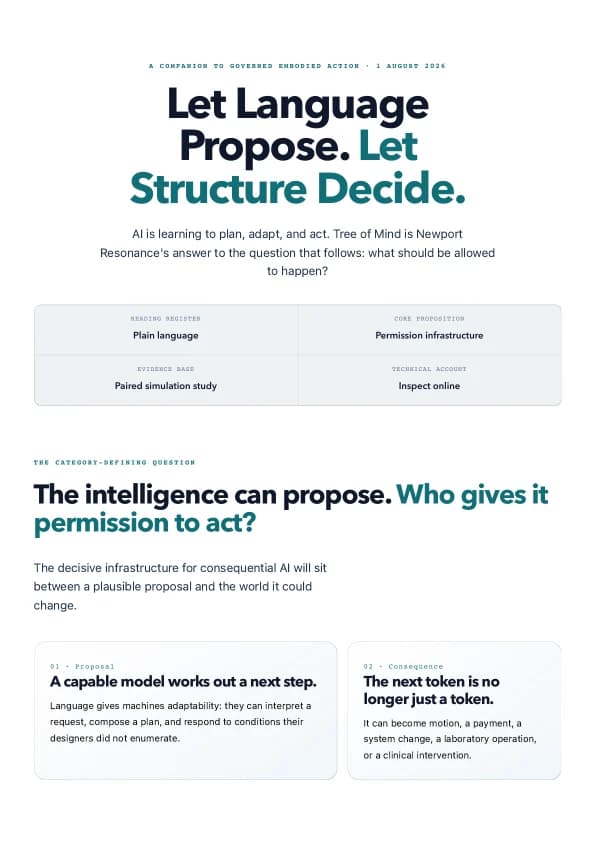
Governed action in simulation

Source: Governed Embodied Action: A Persistent Structural-Mechanics Substrate Supervising an LLM Robot Planner in Simulation

Rule-violating events observed by an independent physics evaluator

Gemma 4 26B local planner · 40 episodes

Ungoverned17 events
Fully governed0 events

gpt-5.5 frontier planner · 40 episodes

Ungoverned12 events
Fully governed0 events

The same supervisor was evaluated behind two planner classes in a paired, pre-registered simulator study. False intervention was 1/20 on benign twins for each planner.

Boundary: One simulator, two planners, simplified execution and small samples. A language-only probe without typed scene contradiction was not caught. This is not a safety certification.

Read the paper
Published technical paper

Evidence judgement

Source: Multi-Step General Reasoning Without an LLM: A Structural-Mechanics Architecture Outperforms GPT-5.2 on a Seven-Family Reasoning Battery

Exact judgement rate on the paper’s direct-comparison sub-battery

40 author-generated evidence-judgement cases

GPT-5.2 baseline32/40 · 80%
Structural reference40/40 · 100%

The paper reports a 20 percentage-point observed difference on the 40-case direct-judgement comparison, with one GPT-5.2 run per case.

Boundary: The taxonomy and battery were author-designed, not independent. One model and one run per case were tested, and model-version or prompt-format variance was not measured.

Read the paper
Published technical paper

Long-context recall

Source: Eliminating Context Rot in Frozen LLMs: A Three-Mode Structural State-Coupling Architecture

Verified recalls at approximately 64K tokens

20 cases pooled across two independently authored pools

Baseline17/20 · 85%
Full condition20/20 · 100%

The study used frozen Gemma 4 26B at 64K tokens. The Wilson 95% interval for the full condition’s 20/20 result was 84–100%.

Boundary: One model, one context size, one benchmark class and a mechanically densified prompt shape. This is preliminary research evidence, not universal context retention.

Read the paper

Research evidence, not product benchmarks. Results apply only to the models, tasks, samples and evaluation conditions described in each linked paper.