ToM Mine · Adaptive haulage decision intelligence
Make the next haulage decision with the whole operating picture.
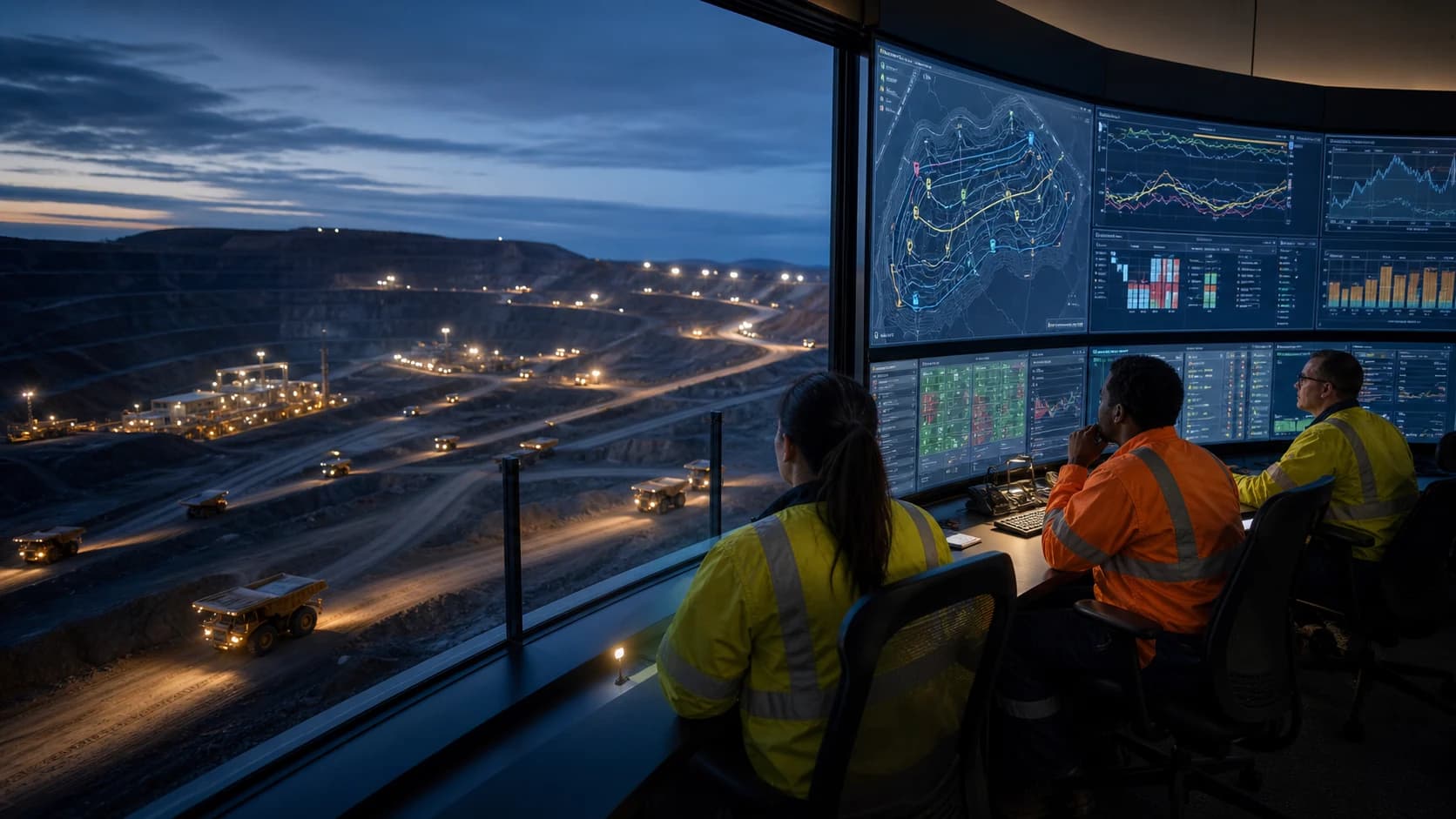
ToM Mine is adaptive decision intelligence for autonomous and mixed-fleet haulage. Its vendor-neutral architecture is built to bring fleet flow, route condition, terrain change, equipment health and production constraints into one time-bounded decision—and turn confirmed results into site-specific operational memory.
Hard operating, evidence and authority constraints remove ineligible options first. ToM compares the feasible responses, selects one current action or abstains, and coordinates the next authorised step through the mine's established people, procedures and systems.
- 01Cross-system haulage context
- 02Hard constraints before economic ranking
- 03Select, abstain or escalate
- 04Compounding site-specific decision memory
The operating gap
The hardest haulage decisions sit between systems.
Modern mines already have capable systems for dispatch, autonomy, positioning, terrain, maintenance, perception and production reporting. ToM Mine joins the state that matters when conditions change together.
A route can remain open in the fleet map while a survey revision changes the usable road. A queue response can improve one circuit while starving another. A maintenance warning can be technically valid but operationally mistimed.
ToM Mine resolves that decision gap: which options remain eligible now, what each is likely to cause, who has authority to act and what evidence will show whether the response worked.
State changes faster than plans
Routes, benches, queues, destinations, equipment state and operating access do not change on the same clock.
Local optimisation can move the delay
Improving one queue, route or asset can create shovel hang, spillback, material mismatch or maintenance exposure elsewhere.
Alerts are not a decision
Operators need one accountable response with scope, deadline, authority and confirmation—not another wall of disconnected warnings.
The haulage decision loop
From operating change to measured outcome.
The product architecture is built around one governed loop that keeps the current state, feasible response set, prediction, authority and confirmed outcome connected.
01
Build the current haulage state
Combine authorised observations from fleet and autonomy systems, registered roads and terrain, maintenance, survey, geotechnical, destination and perception sources—with site, time, source quality and authority intact.
02
Remove ineligible options
Deterministic mine rules reject responses that are unsafe, stale, unauthorised, technically infeasible or unsupported by required evidence. Missing or conflicting evidence tightens the operating state.
03
Predict each feasible consequence
The predictor layer is built to compare queue, travel, cycle, reliability, energy, layout and recovery consequences against a no-action baseline, with forecast horizon, uncertainty and calibration visible.
04
Select one current action—or abstain
ToM receives a closed set of eligible actions and selects one or abstains. Approval, escalation and delegated workflows remain explicit.
05
Confirm the result and improve the next decision
The full loop is designed to join the execution receipt, independently observed effect, prediction error, override and confirmed outcome to the original decision so comparable cases begin with stronger operational memory.
Current state → eligible options → predicted consequences → decision or abstention → authorised execution → observed effect → outcome memory → better next comparison
Product experience
See the operating model in action.
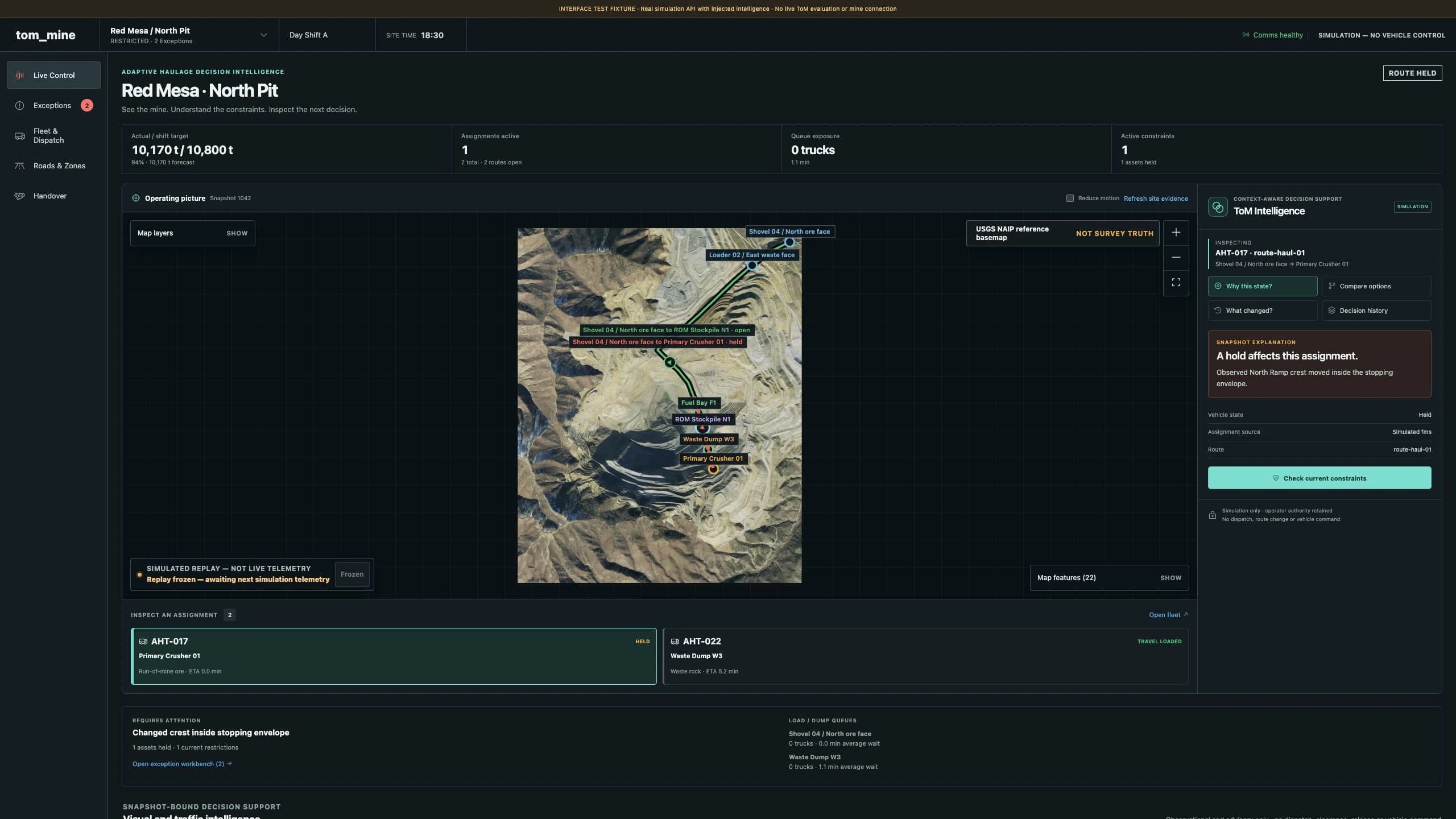
Follow an assignment from its operating context through current constraints, a feasible comparison, selection or abstention, and the original decision record.
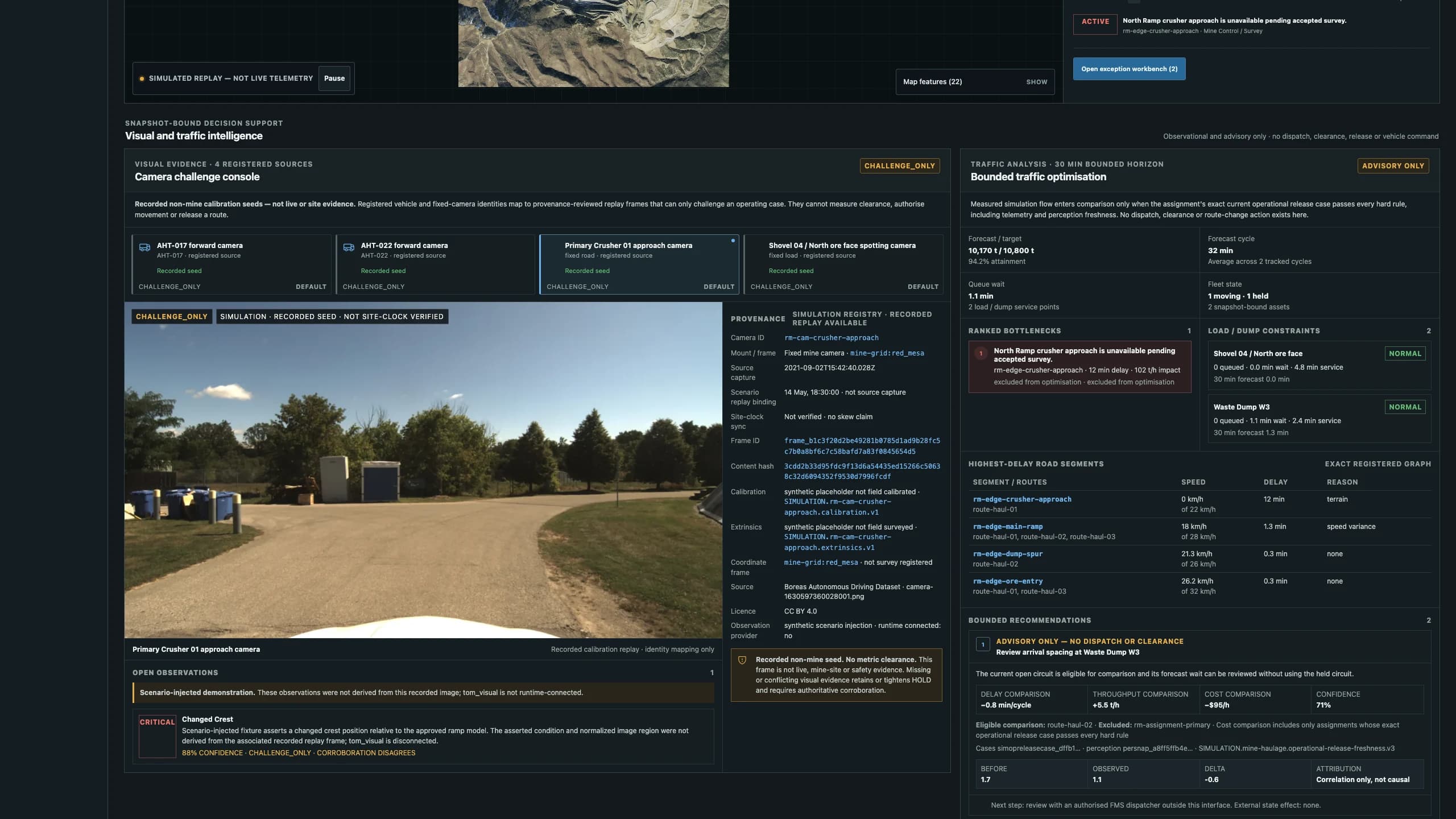
Recorded calibration seed in the perception scene: Boreas Autonomous Driving Dataset — Burnett et al., UTIAS ASRL, CC BY 4.0. Cropped and overlaid; the changed-crest observation is scenario-injected and not derived from the frame.
Inside the operator workspace
Inspect the decision, one question at a time.
Four captured views show how the current interface keeps the selected assignment, constraints, available response and decision history together.
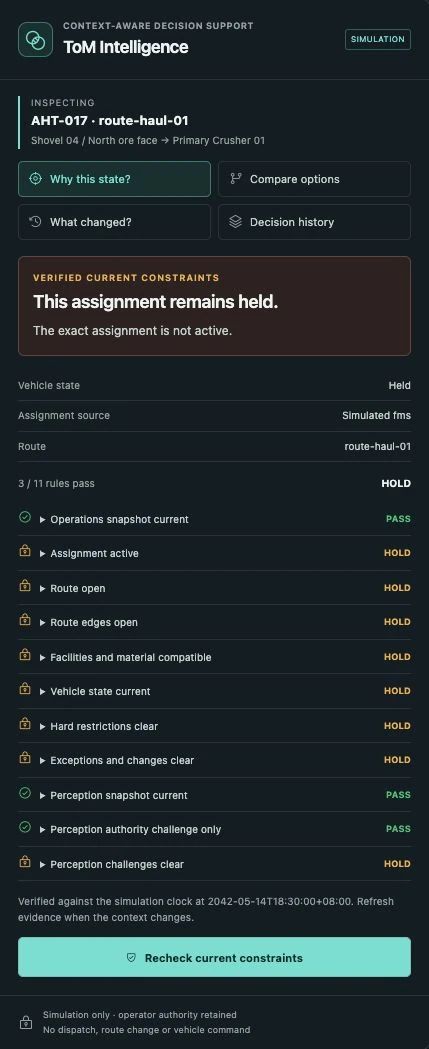
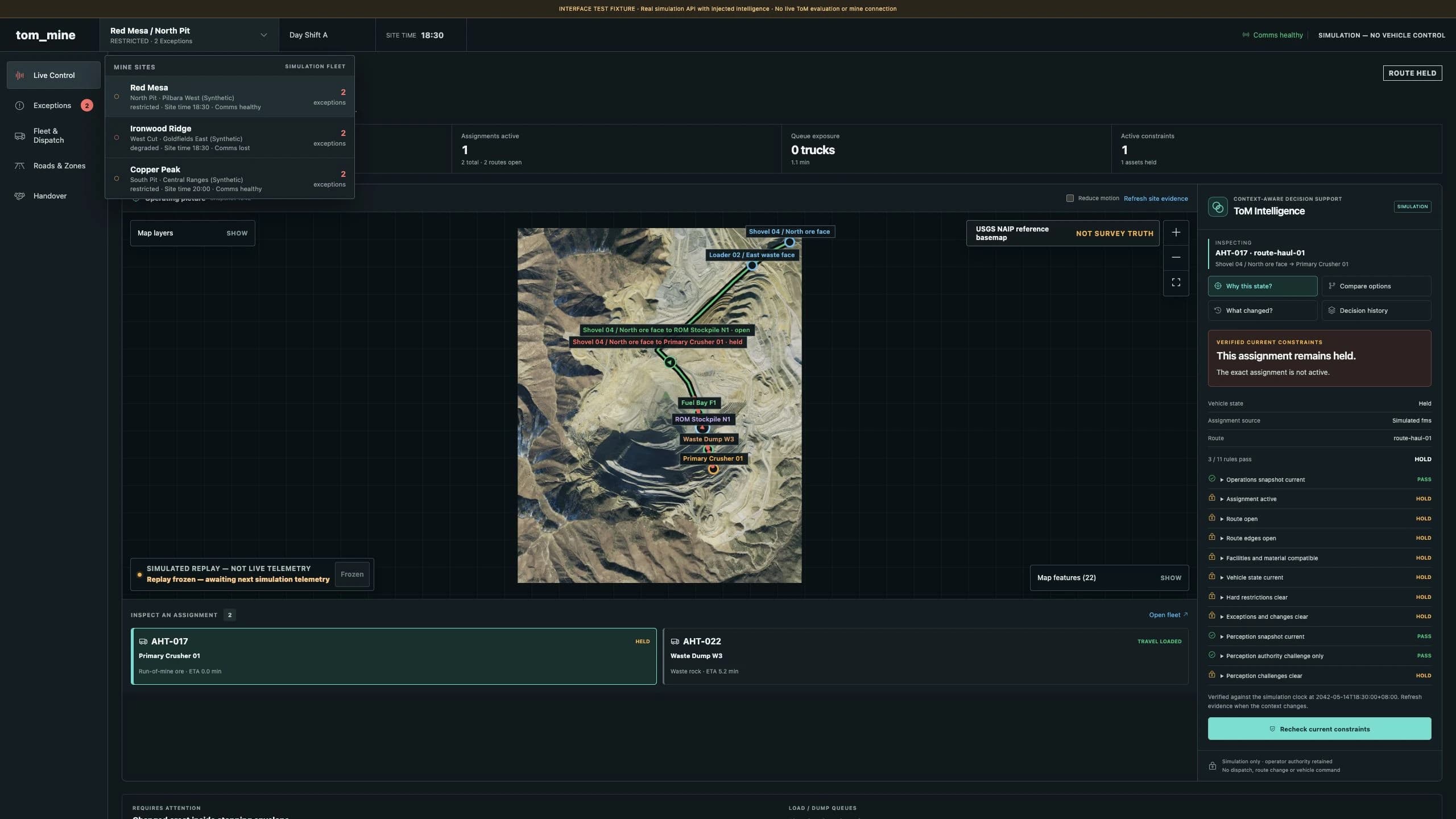
Why is this assignment held?
Start with the selected truck and route. Check the current mine rules and see which conditions keep that exact assignment on hold.
A verified constraint result stays attached to the assignment and simulation clock. A favourable prediction cannot make a failed rule pass.
Actual product interface · simulated mine data · injected test intelligence. These captures demonstrate the interface and decision-record workflow. They do not show a live ToM evaluation, a mine connection or measured production gains. No vehicle control.
Where ToM Mine applies
Focused on the decisions that move haulage.
Six linked decision families connect operational performance to the current evidence and authority behind every response.
Fleet flow and queues
The predictor layer is designed to forecast queue build-up, truck wait, shovel hang, spillback, cycle-time distribution and destination constraints, then compare pacing, staging, substitution and eligible route choices.
Route, road and layout change
The decision model is built to reconcile approved and observed terrain, registered roads, route state, zones, berm or windrow change and geotechnical constraints as the mine evolves.
Reliability and maintenance contingency
The contingency model is built to bring equipment-health evidence together with assignment, route duty, parts, crew, bay and spare capacity to compare operational contingencies.
Interaction and operating boundaries
The operating model is designed to coordinate the wider response to off-path, no-go, proximity or mixed-traffic events while sub-second protection remains with the vehicle, AHS or collision-avoidance system.
Material, destination and energy
The decision context is designed to keep source, payload, compatibility, destination readiness, fuel or charge state and service availability attached to every assignment decision.
Decision efficacy
The outcome loop is built to compare predicted and observed results—including delay, throughput, reliability, override and persistence of benefit—to strengthen future option ranking.
Product capabilities
The operating picture, decision and evidence stay connected.
The map leads. Exact decision intelligence opens where the operator needs it.
Interactive haulage map
Move between permitted sites, pan and zoom, adjust layers, inspect registered roads and facilities, and select vehicles, routes, restrictions and overlapping features.
Fleet and assignment context
See where each truck is collecting, where it is taking material, why that destination applies, which route is registered and what is changing the assignment.
Contextual decision workspace
Select an assignment, ask why it is held, check current hard constraints and compare the product-supplied feasible responses with their predicted baseline deltas. The simulation workspace shows selection or abstention without executing an action.
Evidence and camera context
Open registered vehicle or fixed-camera sources with capture time, latency, health and calibration state visible. Vision can challenge an operating case and request corroboration.
Decision history and bounded replay
Reopen a site decision with its original assignment, context, predictions and selection or abstention intact. Map replay stops when available simulated telemetry ends, and operators can reduce motion. Confirmed-outcome learning remains the designed continuation.
Multi-site separation
Switch between authorised mines and pits without merging assignments, evidence, decisions or memory. Each site retains its own operating context and history.
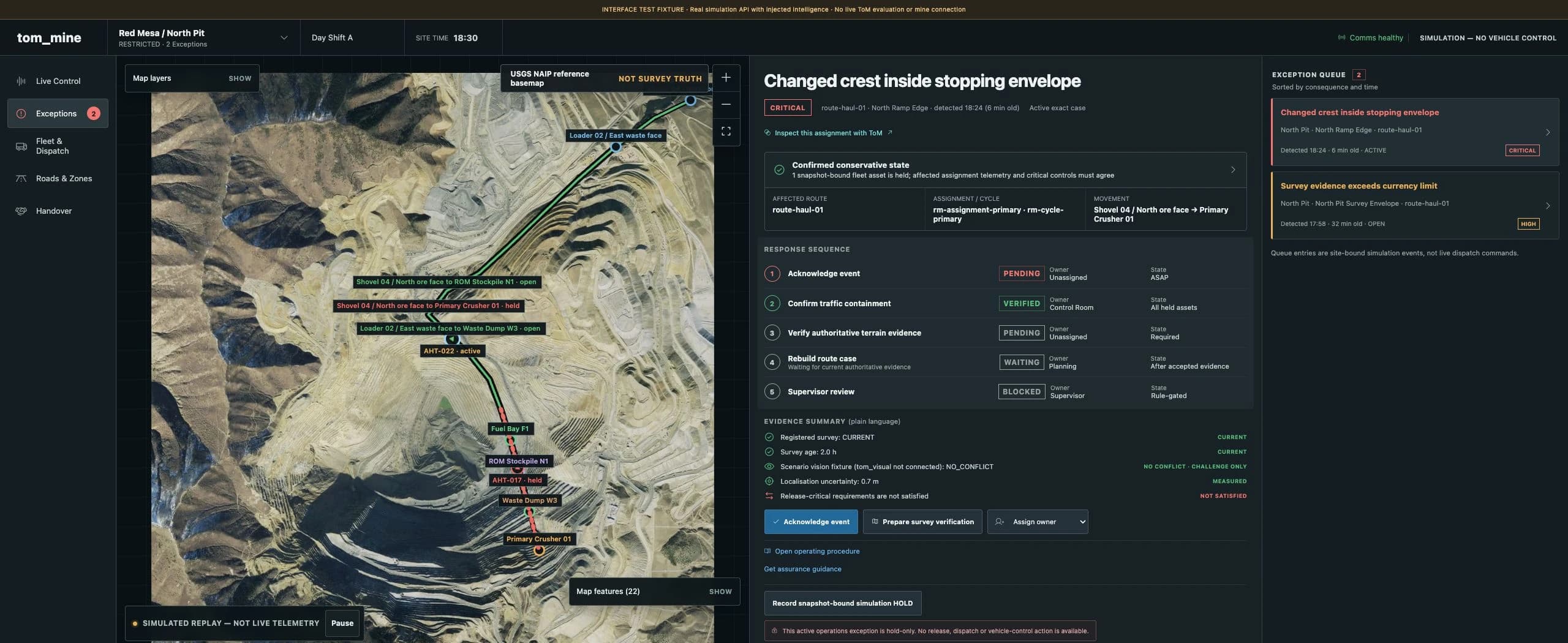
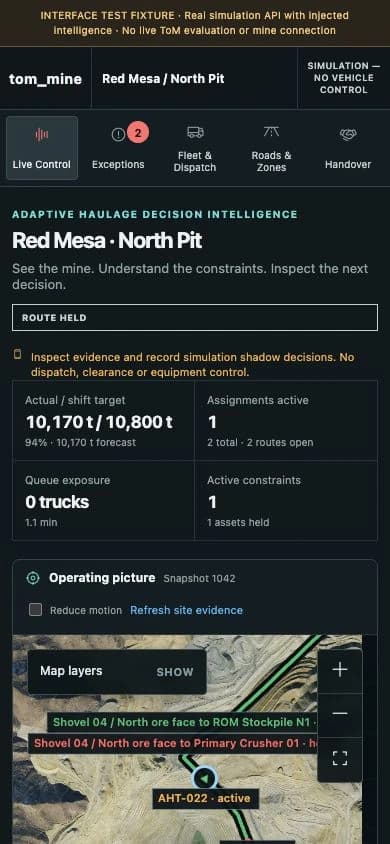

Product interface views use simulated mine data. Refreshed workspace captures use injected test intelligence. Illustrative imagery is identified separately.
The compounding advantage
A decision-and-outcome architecture that compounds on site.
Dispatch, autonomy, terrain, maintenance and simulation solve important parts of operations. ToM Mine joins their consequences into the next accountable decision.
Cross-system executive decisions
The decision architecture is built to select one coherent response across fleet flow, equipment health, maintenance resources, road or slope change, material, destination, energy and uncertainty.
Site-owned decision memory
The current site decision ledger preserves each shadow decision and its original context. The site-owned memory architecture is designed to join confirmed outcomes to those records so later comparisons can benefit from operational experience.
Change-aware context
The context model is built to bind each option and prediction to the current layout, route, fleet, evidence and clock, invalidating dependent decisions when a material input changes.
Graduated autonomy
The autonomy model is designed to match the response to consequence, time, reversibility and delegated authority: notify, recommend, request approval, perform bounded internal work or pass an accepted intent.
Learning cannot weaken the envelope.
The outcome-memory model is designed so confirmed results can improve prediction and option ordering. Learned precedent cannot restore an excluded option, alter a signed rule, grant authority or replace current evidence.
Works with the haulage stack
Add a decision layer. Keep operational authority where it belongs.
ToM Mine's vendor-neutral integration architecture is designed to accept authorised outputs from fleet, autonomy, equipment-health, survey, geotechnical, positioning, destination and perception systems while each source remains authoritative for its own domain.
Vehicle and safety protection
Steering, braking, throttle, collision avoidance, emergency stop and certified safe-state behaviour remain with the vehicle, OEM AHS or configured protection system.
Haulage decision
ToM selects one already-eligible product action or abstains. It cannot invent a command, make a failed rule pass or convert missing evidence into permission.
Operational execution
Where a site delegates execution, the contract requires an accepted adapter, exact site authority, current-state revalidation, idempotency, expiry, an executor receipt and independent effect confirmation.
Human authority
Route release, geotechnical clearance, signed-rule change, strategic configuration and non-delegated actions remain with authenticated, competent mine roles.
ToM Mine is built to own the cross-system haulage decision record and revalidate current state before a bounded intent passes to an accepted site workflow. A configured operator or mine role retains release and strategic-change authority.
Frequently asked questions
Built around the mine systems and authority you already use.
ToM Mine expands the decision context without replacing the controls that already govern vehicle motion, ground clearance or mine operations.
How does ToM Mine work with existing AHS and fleet-management systems?
ToM Mine places cross-system decision intelligence around the existing autonomy and fleet stack. AHS and FMS platforms retain vehicle motion, dispatch execution and configured protection functions, while ToM Mine combines their authorised state with route, terrain, maintenance and production constraints in the wider haulage decision.
What decisions can it support?
Fleet flow and queues, route and layout change, maintenance contingencies, material and destination constraints, energy or service timing, operating-boundary events and the effectiveness of earlier decisions.
Can production value outweigh a safety constraint?
No. Safety, legal, evidence, technical and authority constraints exclude options before throughput, delay, cost, material or energy is compared. ToM abstains or requests evidence when the eligible set or prediction quality is insufficient.
How does continuous improvement work?
The continuous-improvement architecture is built to compare each prediction with independently observed execution, override, error and persistence of benefit. Confirmed outcomes can inform later predictions and option ordering while hard rules, current evidence and operating authority remain fixed constraints.
Can ToM Mine use onboard or site cameras?
Yes. The perception contract is designed to accept calibrated, provenance-bearing observations from authorised camera and perception providers. Vision evidence can identify possible obstacles, edge or windrow change, missing coverage and source disagreement, tightening the operating case and requesting corroboration where required.
Is site data pooled across mines?
Each permitted site retains a separate operating state, local time, fleet, routes, evidence and decision context. The product architecture is designed so high-rate streams can remain in their authoritative systems while bounded decision context and outcome records are processed under the site’s data policy.
Start with one decision loop
Bring us the haulage decision your systems cannot resolve alone.
Begin with one route, queue, maintenance or layout-change workflow. We will define the current evidence, hard constraints, feasible responses, baseline decision process and outcome measures with your site team.
Sponsor
Mine control, autonomy or operations excellence
Decision family
One recurring, measurable haulage decision
Evidence
Authoritative inputs, baseline, outcomes and decision owner