Attention
See what needs inspection.
Prioritise concurrent sessions and name the current issue: a failed gate, missing proof, stale evidence, possible drift or unsafe continuity.
Product preview · AI coding-agent assurance
ToM Bar is a native macOS session-assurance monitor for work in the AI coding agents Codex and Claude Code. It checks whether the accepted objective still governs the session, identifies what remains failed, stale or unproven, and shows the next issue to inspect before a weak result becomes a bad decision.
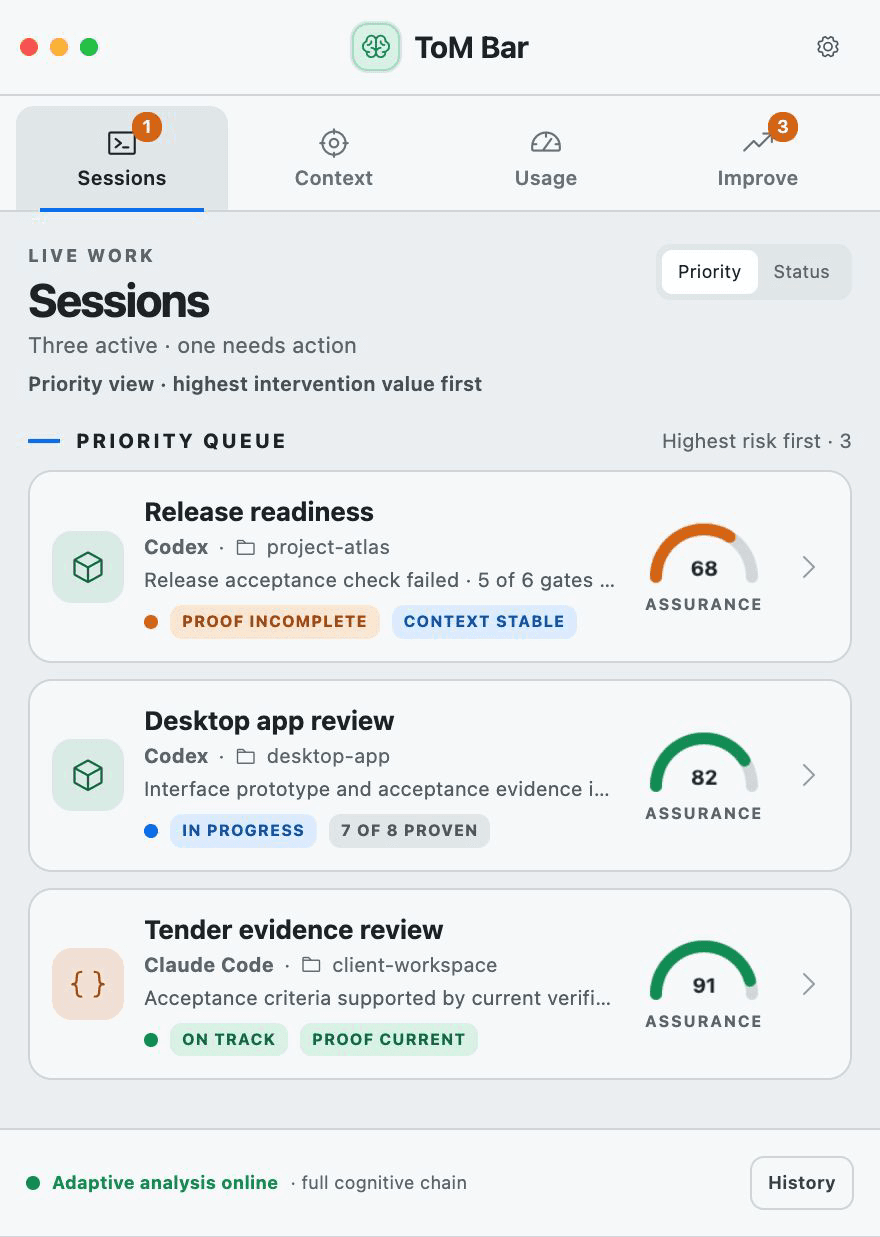
The assurance gap
AI coding agents can work for hours, compact context, launch sub-agents and produce a convincing completion claim. The harder question is whether the current Codex or Claude Code session still reflects what the user asked for—and whether the result has current proof.
Attention
Prioritise concurrent sessions and name the current issue: a failed gate, missing proof, stale evidence, possible drift or unsafe continuity.
Basis
Keep judgments tied to what ToM Bar could actually observe, with partial states when analysis coverage or provenance is insufficient.
Action
Prepare a bounded follow-up or completion plan, then wait for fresh evidence before reporting that the issue improved.
Product walkthrough
Use the four steps to inspect how ToM Bar keeps context, assurance, proof and usage distinct. The controls navigate this explanation; they do not operate or simulate the product.
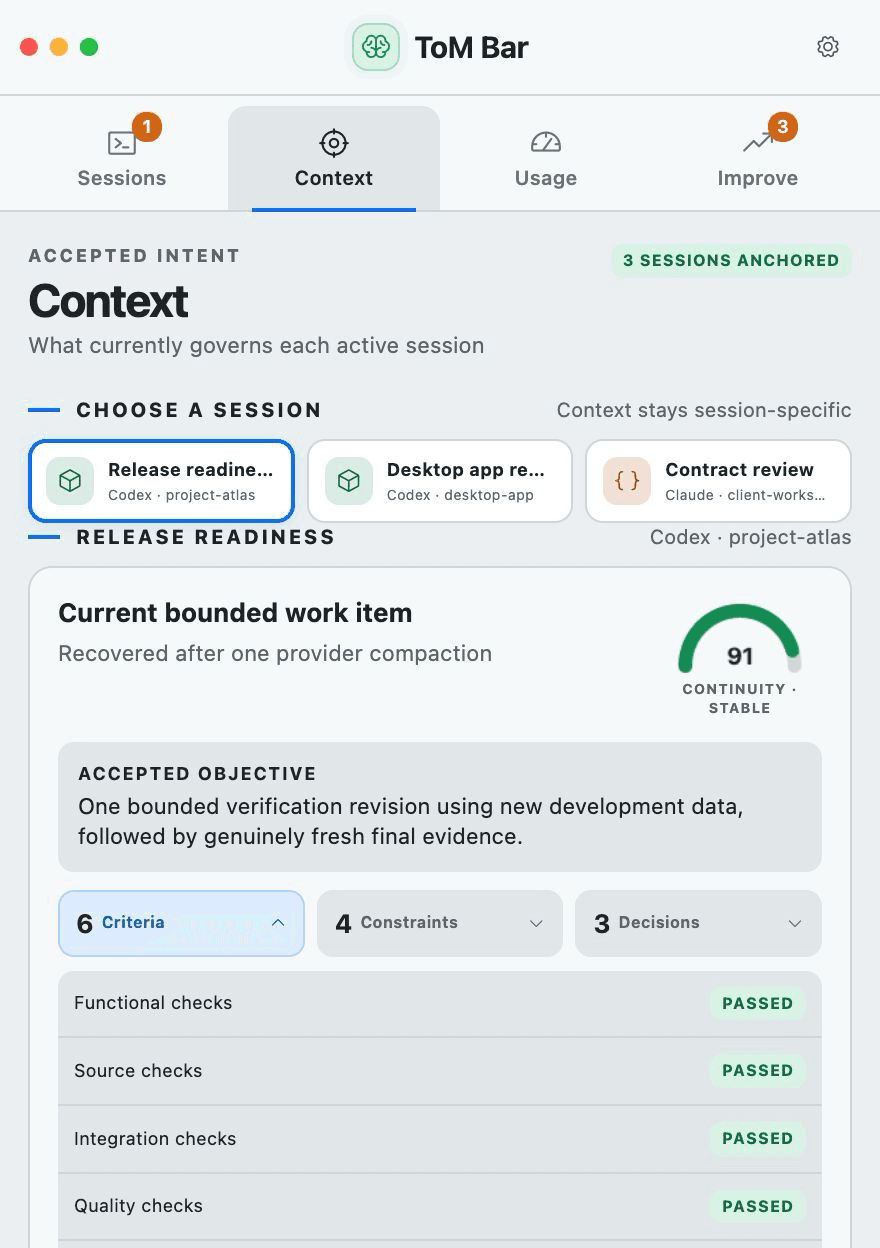
Walkthrough 01
Inspect the objective, criteria, constraints and decisions that currently govern one session. Context remains session-specific, even when several agents are active.
Continuity measures describe whether accepted intent survives in the observed work. They do not certify that the task is complete or correct.
Deterministic product prototype; illustrative session and usage data.
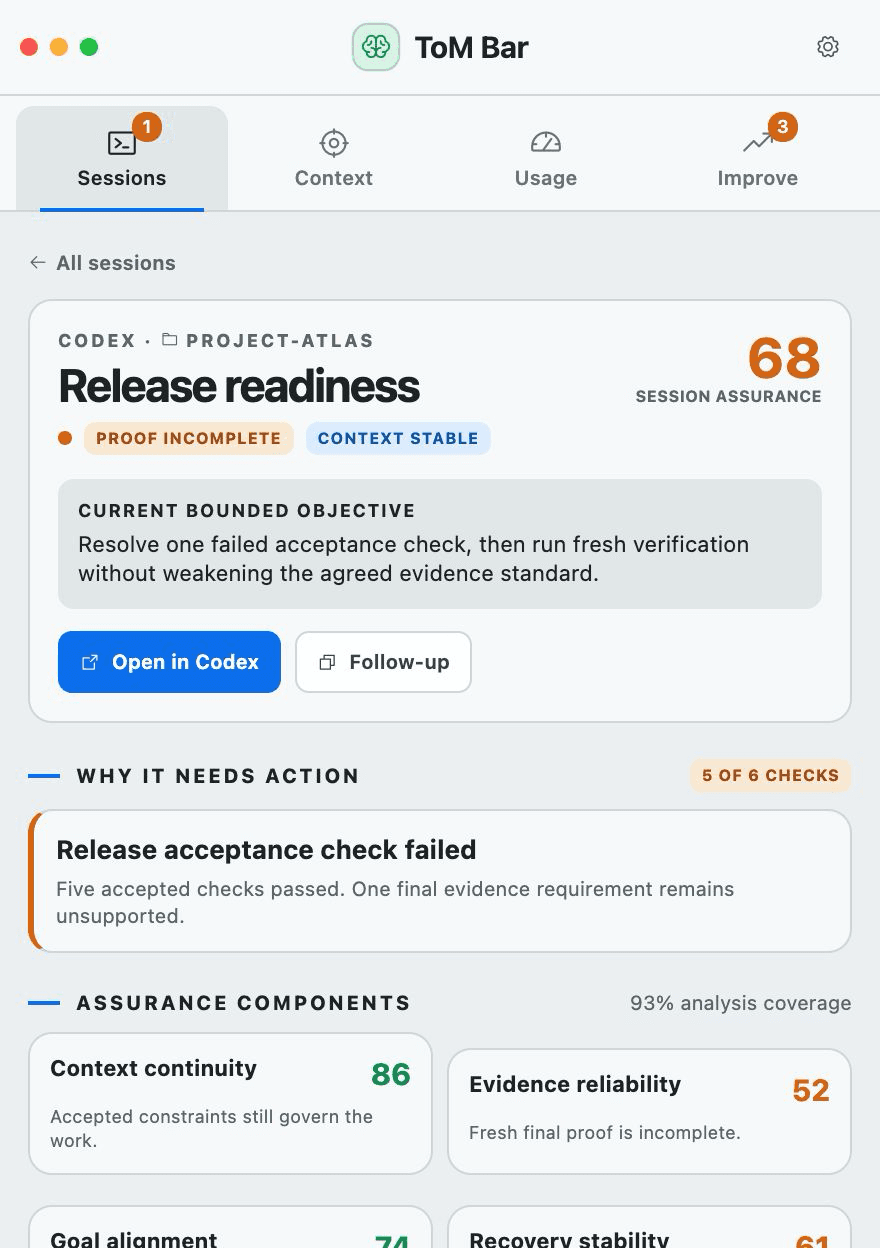
Walkthrough 02
ToM Bar identifies a failed gate, stale evidence, missing proof or possible drift in task-specific language instead of reducing every signal to a generic warning.
The detail view keeps the active session, bounded objective and observed evidence together so the user can decide whether to continue, verify, correct or restart.
Deterministic product prototype; illustrative session and usage data.
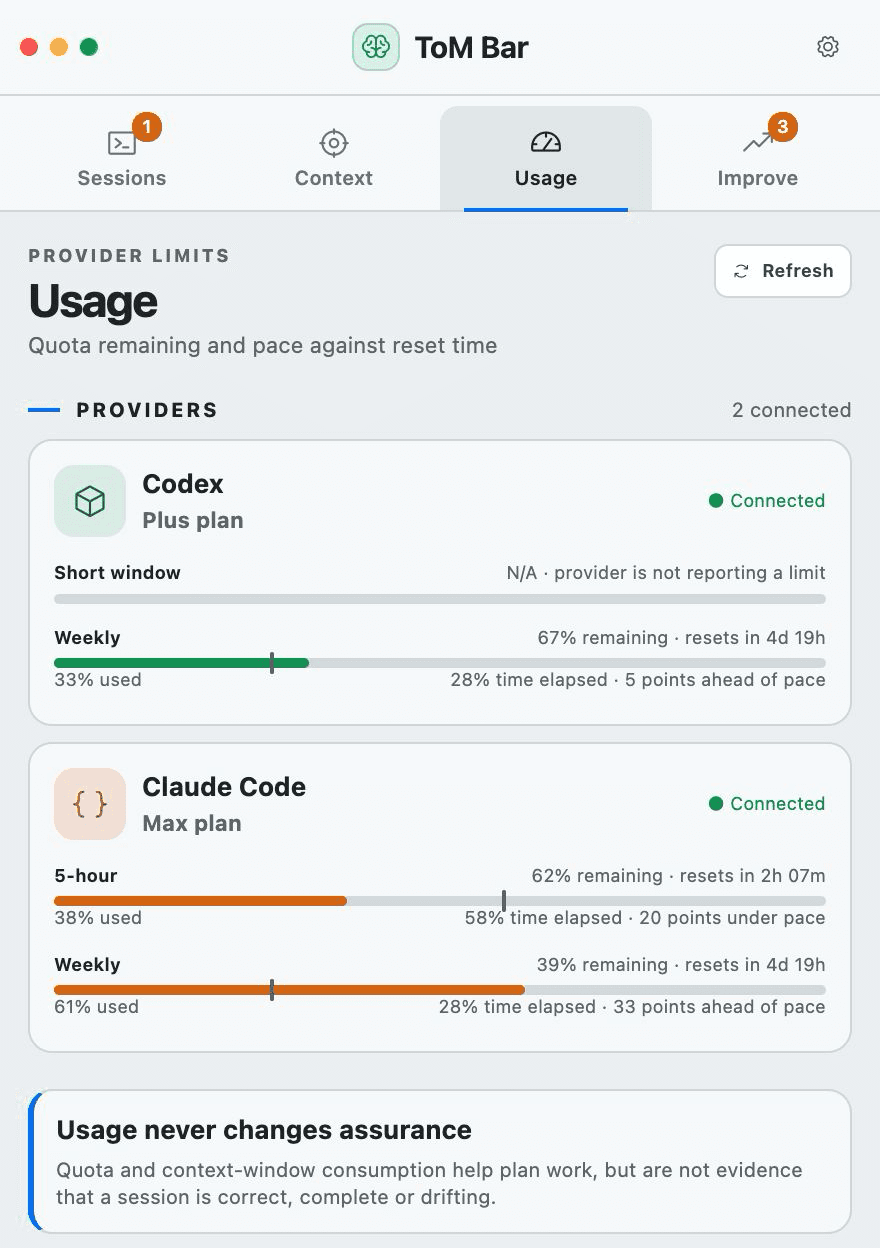
Walkthrough 03
Provider quotas and pace can help plan the work. They remain separate from Session Assurance and from the tests, builds and criterion-bound evidence needed to support completion.
Where a provider does not expose a limit, ToM Bar reports N/A. It does not invent consumption data or use activity as evidence that the work is reliable.
Deterministic product prototype; illustrative session and usage data.
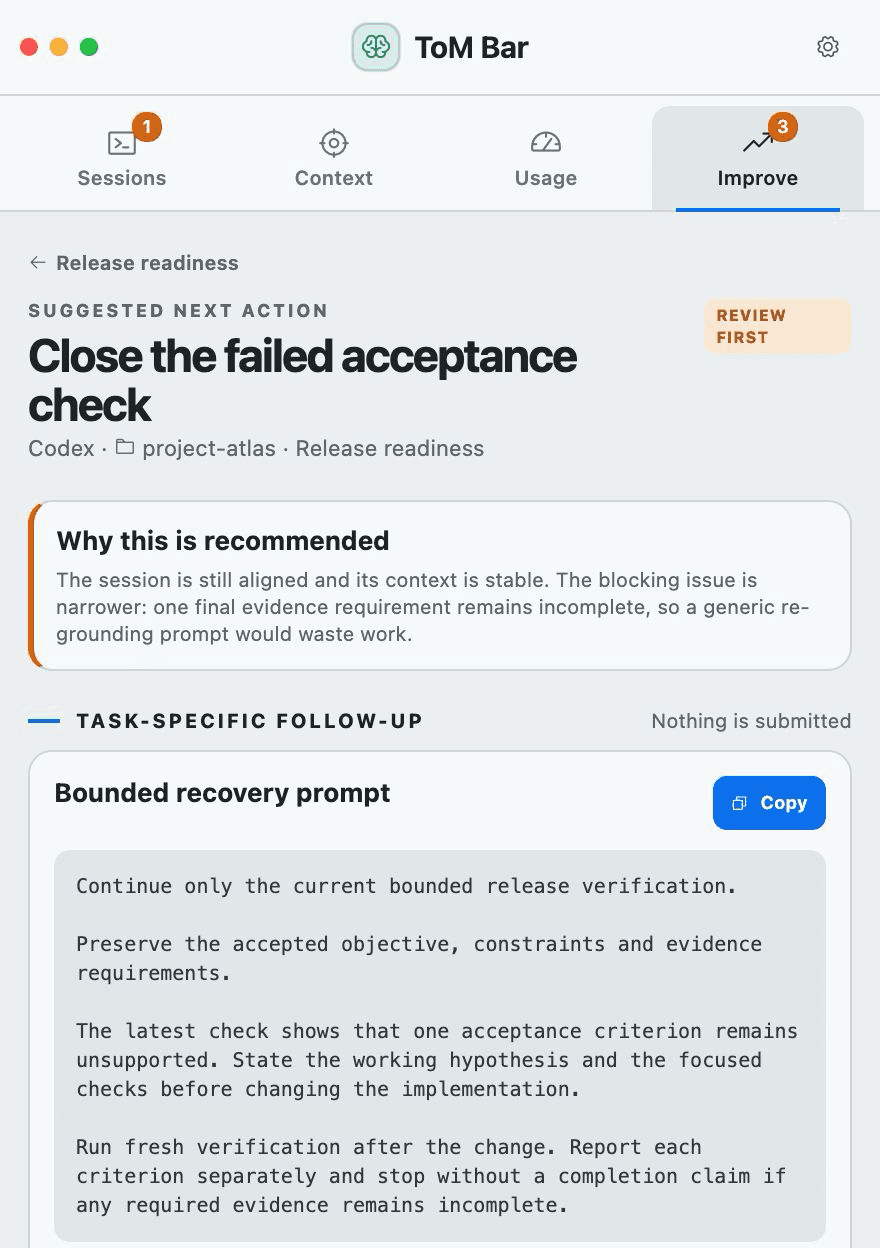
Walkthrough 04
When a session needs attention, ToM Bar can prepare a task-specific follow-up that preserves the accepted objective, constraints, blocker, required proof and stop conditions.
The user reviews and controls every provider action. Copying a prompt is not treated as a fix; the judgment changes only after fresh, relevant evidence is observed.
Deterministic product prototype; illustrative session and usage data.
Evidence before confidence
ToM Bar is designed to help people decide whether to rely on an observed session. It does not compress assurance, completion and consumption into one impressive-looking score.
A ToM-owned view of observed continuity, evidence reliability, goal alignment and recovery stability. It is not a probability that an answer is correct.
Tests, builds, sources and criterion-bound evidence remain visible as their own question. Healthy continuity does not prove the work is complete.
Quota and context-window consumption are shown only when the provider exposes them. Usage does not raise or lower Session Assurance.
Private by design
ToM Bar is designed for local, privacy-conscious operation. Durable continuity uses encrypted derived metadata, hashes and evidence references rather than a stored copy of the conversation. Provider authentication remains with the provider integration.
Explore the product direction
Talk with Newport Resonance about the ToM Bar product direction, live-session assurance and the broader ToM cognitive intelligence system.