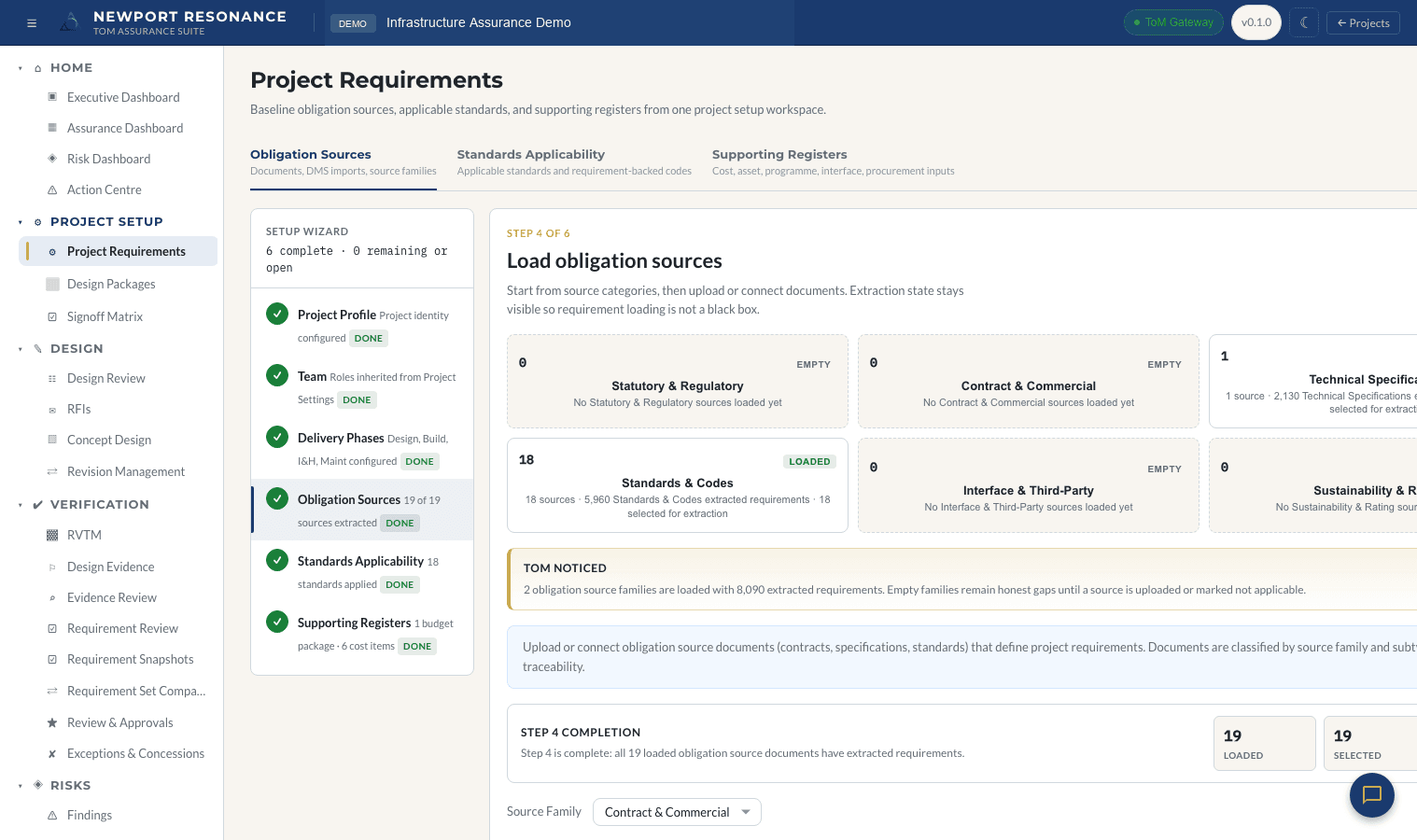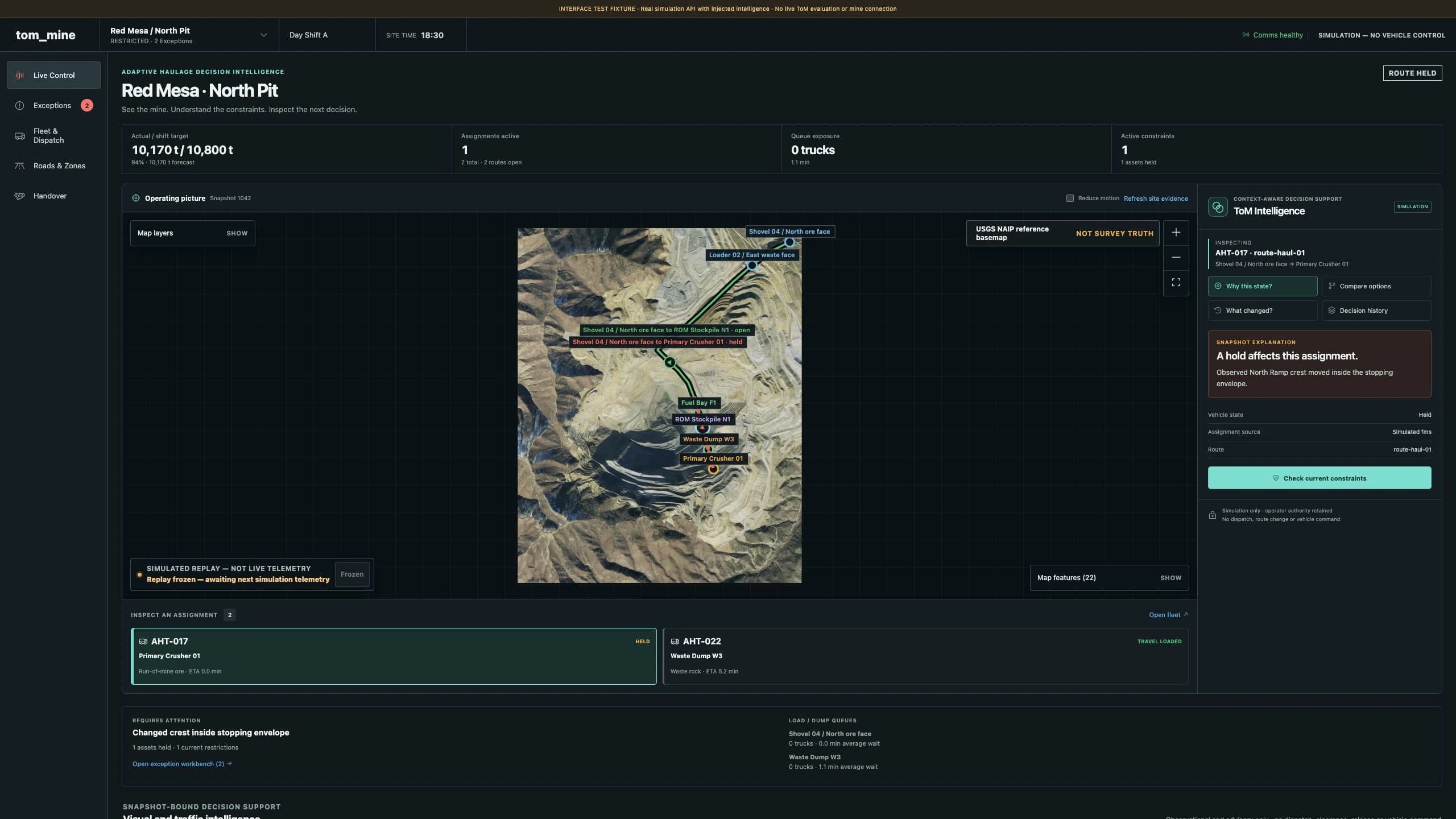
01 · AI recommendation
“Move the robot arm there.”
The model uses the instructions, data, and context currently available to propose a plausible next step.
Useful reasoning. No automatic authority.
Newport Resonance · Introducing ToM
Adaptive governance and persistent memory for AI. Built to keep evidence, operating limits, and human authority in view.
An independent AI company. A framework for decisions that matter.
ExploreHow ToM works
AI can overlook a requirement, accept an unchecked result, or act on outdated information. ToM brings evidence, operating limits and human authority into the decision—so connected workflows can check what is supported and permitted before proceeding.
01 · AI recommendation
The model uses the instructions, data, and context currently available to propose a plausible next step.
Useful reasoning. No automatic authority.
02 · ToM checks
Select a check
03 · Governed workflow
The surrounding system determines what may proceed and preserves a reviewable record of the context, evidence, rule, and authority involved.
ToM does not assume the model is correct or replace required human approval. Where configured, it preserves what was proposed, what was checked, and why the workflow reached its outcome.
See the full governed architectureProducts
Explore the products bringing ToM into project decisions, industrial autonomy, and professional workflows.
Make bounded protective decisions across uncertain air and drone scenarios.
ExploreKnow when an AI-agent session is still worth trusting.
ExploreBring planning, feasibility, and delivery into one view.
ExploreAdd governed advice without rewriting the CRM.
ExploreReview technical PDFs with less friction.
ExploreThe framework behind the products
Language models can recommend. They should not decide alone. Context can drift, evidence can change, and a plausible next step can fall outside a person's authority.
ToM makes the language model one reasoning component within a persistent, governed framework. Its self-evolving algorithms learn from resolved outcomes; policy, action limits, approvals, and human authority remain in control.
Applications
Explore robot-assisted spinal instrumentation, autonomous mine haulage, integrated air defence and bushfire grid restoration through the evidence, operating controls and accountable authority that determine whether a proposed action is eligible now.
Newport Resonance currently prioritises high-consequence surgical systems, followed by industrial autonomy, defence and critical infrastructure.
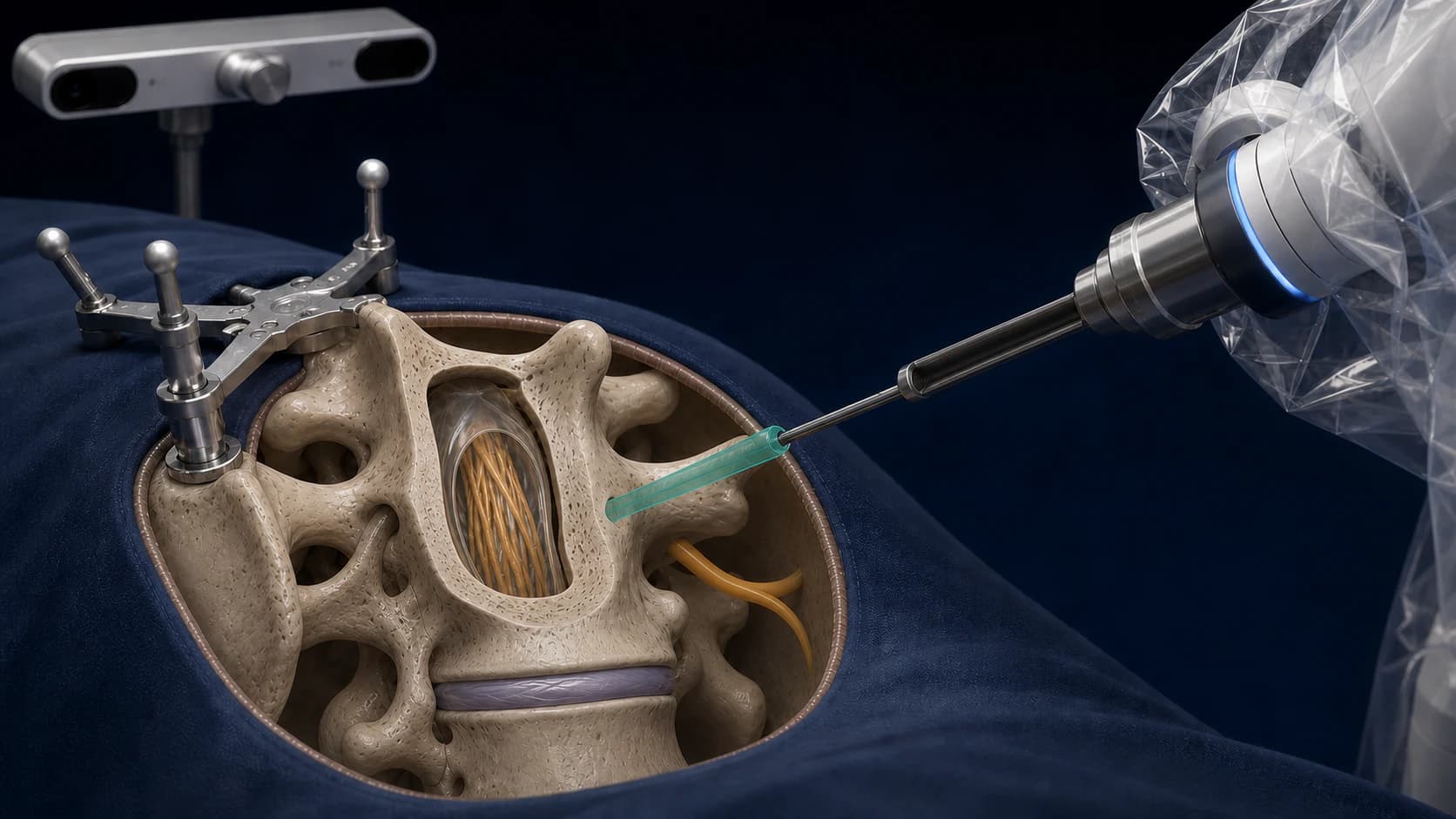
01 · Surgical robotics · L4–L5 lumbar fusion
Govern an AI-proposed pedicle-screw trajectory against the current patient registration, approved L4–L5 plan and spine-surgeon authority before instrument advance.
Operating lens: each application makes the proposed action, evidence requirements, operating limits, authority and consequence visible together.
Newport Resonance research · controlled simulation
Newport Resonance tested two language models as planners: Gemma 4 26B running locally and gpt-5.5 through an API. For each case, the same proposed plan was replayed without ToM governing release and with the same ToM supervisor in place.
The models proposed the actions. When those plans were released directly, the evaluator recorded 17 specified rule-violating events for Gemma and 12 for gpt-5.5. When ToM governed release of the identical sampled plans, it recorded zero for both planners.
Browse all researchGoverned action in simulation
Newport Resonance replayed the same sampled plans under two release conditions. The models proposed the actions; the simulator measured the specified rule violations that were executed.
Condition A
Direct planner release
The LLM-generated plan was released directly into the simulator.
Condition B
ToM-governed release
The identical sampled plan passed through ToM before execution.
Outcome measure
Executed rule violations
The simulator evaluator counted the specified rule-violating events executed.
Local · open weights
recorded violations
Frontier · API
recorded violations
Build with Newport Resonance
Explore a product, discuss an enterprise decision path, or talk with us about research, partnership, and investment.