Infrastructure · Project risk
AI construction document review: from finding to decision
AI construction document review helps a project team find inconsistencies, missing evidence and changes that deserve attention across drawings, specifications and related records. Its useful output is a reviewable finding: where the issue appears, what decision it could affect, what is still uncertain and who should investigate.
- Start with a project decision and the authorised document set that supports it.
- Ask the tool to distinguish a contradiction from missing or ambiguous evidence.
- Evaluate the complete route from a source finding to an accountable review decision.
Choose the decision that needs better evidence
A design manager may need to understand the effect of a revised layout before issuing a package. A commercial manager may need the technical basis for assessing a changed scope. A reviewer may need to know whether a specification obligation is supported by the current design. These are related uses of document review, but each needs a different acceptance basis and next action.
Write that decision down before selecting software or uploading a large document collection. Identify the project stage, affected package, relevant disciplines and the people who can resolve findings. For a first evaluation, a contained review with known issues and a clear next milestone gives more useful evidence than a general request to find every project risk.
Establish which documents govern the review
Identify the approved drawing issues, applicable specifications, design criteria, relevant contract clauses and interface records. Keep document identities, revisions, issue purposes and source locations. Where the records disagree, the project authority must establish precedence; an AI-generated answer should not silently decide which source controls.
For construction specification review, ask whether an obligation actually applies to the asset and project stage. A product specification, a workmanship clause and an acceptance test describe different things. Preserve the source wording and identify missing acceptance criteria so that a shorter summary does not change the requirement.
Configuration management connects proposed changes, their assessment, authorised decisions and the released configuration. NASA’s systems-engineering guidance provides useful general principles; the project’s own contract and management system determine the applicable review process.
Follow a finding into its possible consequences
Require the proposed finding to identify an exact sheet, region, clause or record, together with the version assessed. The explanation should tell another reviewer why the source matters and which decision may depend on it. A general answer with a list of filenames is difficult to investigate.
Check the effect across discipline and package boundaries. An issue may require design clarification, a revised calculation, an interface conversation or a commercial/programme assessment. The review finding identifies that work; quantifying cost, entitlement or delay requires the relevant project records and competent assessment.
| Record | What a reviewer needs |
|---|---|
| Source | Document identity, revision, page or drawing region, and the clause or observation. |
| Issue | The specific mismatch, missing evidence or ambiguity, with the basis for that interpretation. |
| Consequence | The affected design, interface, delivery assumption or review decision. |
| Uncertainty | What cannot be determined from the available records and what would resolve it. |
| Owner and action | The responsible discipline or role, requested assessment and relevant milestone. |
| Disposition | The authorised outcome, its rationale, conditions and evidence used to close it. |
Evaluate construction design review software on a real workflow
Use an authorised sample pack that includes known issues, clean material and at least one revision. Ask the review team to define the expected findings before running the evaluation. Record the product version, configuration, documents assessed and any external model or data-processing route. Do not send project-confidential material through a new service until the project permits that route.
Check findings against the original sources. Count useful findings, incorrect suggestions and known issues missed within this sample. Also record time spent validating or correcting the output. A fluent report or a high extraction count does not show whether the tool improves the review decision.
Test the handover: can another reviewer locate the source, understand the open question, assign the next action and preserve the decision through a later revision? Collaborative markup, specification authoring, document search and evidence-based review are different workflows. Select the combination the team actually needs.
- Include a genuine contradiction, an evidence gap and an unaffected item.
- Check scanned and native-text documents separately where both occur in the project.
- Record reviewer effort and unresolved issues alongside any time saved.
- Repeat the affected part of the review after a controlled revision.
How ToM Assurance Suite connects the review
ToM Assurance Suite by Newport Resonance connects source obligations, engineering drawings, interfaces, evidence candidates and reviewer decisions. Its public product walkthrough shows source intake, requirements setup, design evidence, interface risk and advisory recommendations. The purpose is to keep the project context behind a finding available as the review progresses.
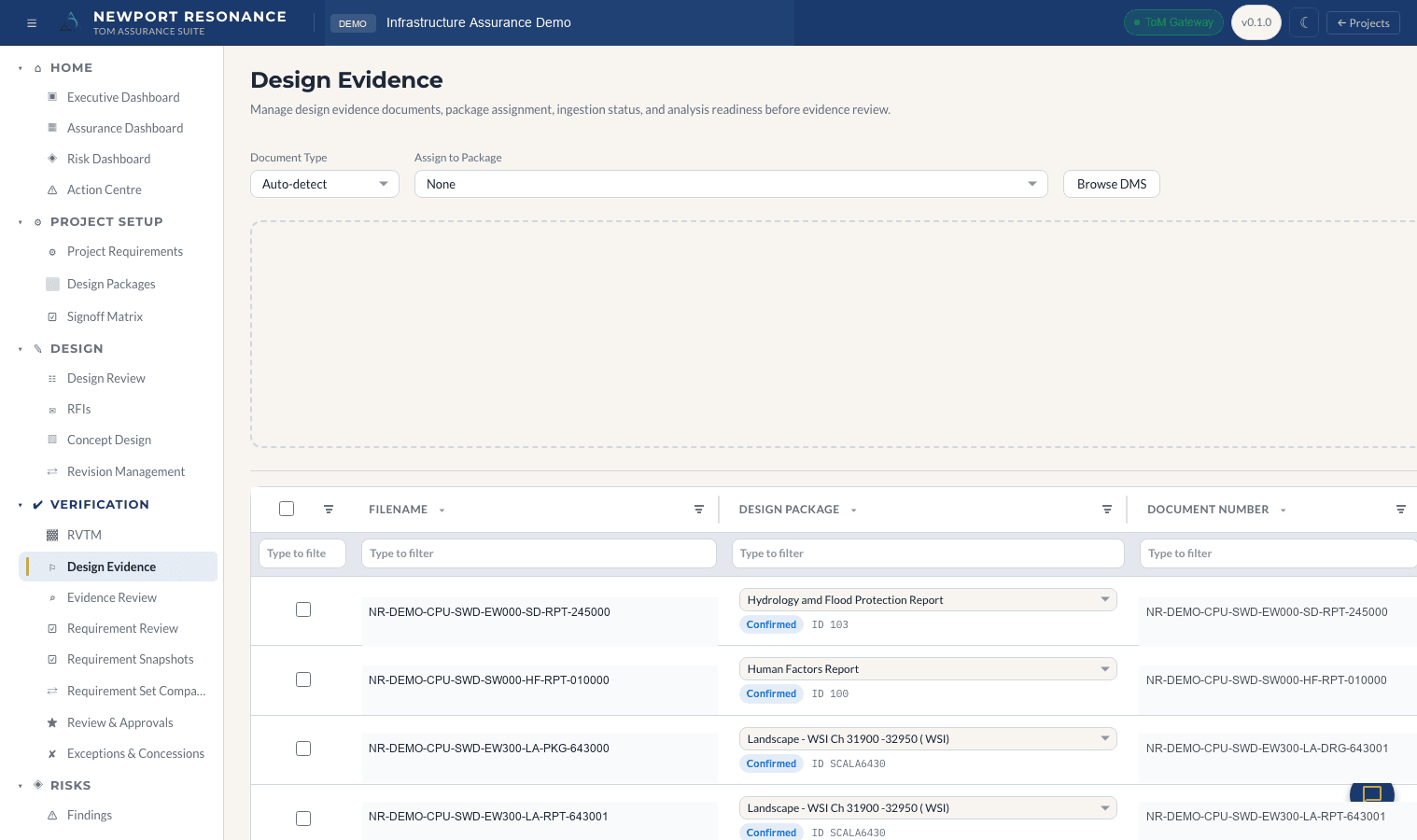
The design-evidence screen below shows document identities and package assignments in the local demonstration product. This is an intake and readiness view. The worked cabinet example above explains a review method; it is not a measured result from the pictured project.
A useful first evaluation can follow one design change or one drawing/specification review through the connected record. Define what the team needs to establish, which source systems are in scope and who retains acceptance authority. Requirements traceability then supports the decision rather than becoming the goal of the exercise.
Explore the ToM Assurance Suite product walkthrough
Before choosing a document-review workflow
- The review decision, project scope, responsible roles and source revisions are agreed.
- Findings distinguish contradictory, missing and ambiguous evidence.
- Every material issue points to a precise source and explains its possible consequence.
- The evaluation includes known issues and clean material, with misses and false findings recorded.
- Reviewers can preserve the decision record through a document revision.
- Data handling, integration scope and acceptance authority are clear.
ToM Assurance Suite
Explore project risk and decision support across document review, design evidence and the consequences of change.